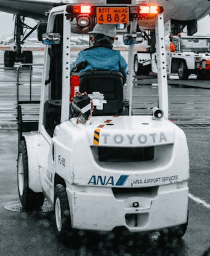
Toyota 8FBN electric forklifts (8FBN15–30) can be charged in two ways: with an on-truck charger built into the truck, or with a separate off-truck charger on the floor or wall. This page explains both, lists which charger matches each model and battery, and gives the transformer data and the charger self-test from the Toyota repair manual. For battery sizes, testing and electrolyte care, see our Toyota 8FBN electric forklift guide.
On-truck or off-truck charger?
| On-truck charger | Off-truck charger | |
|---|---|---|
| Where it is | Inside the truck, under the rear cover: transformer, cooling fan and charger panel | Separate unit (Beijing Delong “econ charger II” or GS Yuasa), connected with the battery plug |
| Power supply | 3-phase AC 200 V (200–220 V taps), 50/60 Hz, via the truck’s AC plug | 3-phase AC 200 V or 400 V, depending on the model |
| Control | Charging handled by the truck controller; status on the truck display | Charger’s own panel (normal, equalize, stop) |
| Best for | Charging wherever there is a socket, no charging room needed | Fleets with a charging area; lighter truck |
On-truck charger list (option)
| Supply | Transformer (kVA, 50/60 Hz) | Battery | Battery capacity (Ah/5 h) | Supply breaker (50/60 Hz) | Models |
|---|---|---|---|---|---|
| 200 V | 5.7 / 6.3 | 48 V | 390 | 20 / 20 A | 8FBN15, 8FBN18 |
| 200 V | 7.4 / 7.6 | 48 V | 470–565 | 30 / 30 A | 8FBN15, 18, 20, 25 |
| 200 V | 10.4 / 10.3 | 48 V | 645–725 | 40 / 30 A | 8FBN20, 8FBN25 |
| 200 V | 9.5 / 9.3 | 80 V | 370–470 | 30 / 30 A | 8FBN30 |
Transformer data
| Battery | Diodes | Fuse | Thermo switch | Transformer weight |
|---|---|---|---|---|
| 48 V 390 Ah (1 t) | SKR71/02, SKN71/02 | BFS 80 A | 130 °C | 34 ± 3 kg |
| 48 V 470–565 Ah (1–2 t) | SKR100/04, SKN100/04 | BFS 100 A | 130 °C | 39 ± 4 kg |
| 48 V 645–725 Ah (2 t) | SKR130/02, SKN130/02 | BFS 150 A | 140 °C | 45 ± 4 kg |
| 80 V 370–470 Ah (3 t) | SKR70/04, SKN70/04 | BFS1.5 80 A | 120 °C | 50 ± 5 kg |
All transformers are 3-phase 200 V, insulation class H, with a thermo switch that stops charging if the transformer overheats. Check the rated indication label (part number, kVA and battery range) before ordering a replacement, so the transformer matches the battery fitted.
Setting the transformer tap
The transformer has four taps (A–D). Choose the tap that matches the local supply voltage and frequency, and mark it on the tap indication label:
| Supply voltage | Tap at 50 Hz | Tap at 60 Hz |
|---|---|---|
| 200 V | B | A |
| 210 V | C | B |
| 220 V | D | C |
A wrong tap gives an under- or over-charged battery. Where the supply is 380–415 V, the on-truck charger needs a step-down supply; an off-truck 400 V charger is usually the simpler choice.
Removing the on-truck charger
- Before starting: key OFF and battery plug disconnected. Remove the battery hood (disconnect the seat switch connector and leave the damper on the truck), the rear cover, the controller upper cover, the rear pillar covers and the battery guard.
- Cooling fan: disconnect the connector, remove the bolts and lift the fan out.
- Charger panel (magnet switch, charger switch, AC plug): disconnect the two connectors and remove the bolts.
- Transformer: disconnect the cables and remove the bolts. It weighs about 40 kg (1 t series), 50 kg (2 t) or 55 kg (3 t): lift it with a hoist and wire rope.
- Installation is the reverse of removal.
On-truck charger inspection (timer test)
Toyota checks the on-truck charger with a built-in timer test, done on the truck:
- Connect the AC plug. All LEDs on the operation panel should light, then go out after 2 seconds.
- Check that the display screen changes to the charging screen.
- Hold the START and STOP buttons together for more than 2 seconds until a beep sounds. All LEDs light: the charger is waiting for the timer test.
- Press START within 5 seconds. The timer test begins.
- Watch the test: each LED should light in turn while the others are off, the magnet switch should click on and off, and no error should appear.
- At the end, the display shows “TEST-o” (multi-function display: “TEST COMPLETED”), and the battery indicator steps through all 10 stages.
- Press the decision button and check that the display returns to the normal charging screen.
- Disconnect the AC plug.
If the LEDs or display do not come on, press STOP, unplug, and check that 200 V AC actually reaches the AC plug. If the supply is correct and the panel still does not respond, the charger panel or transformer circuit is faulty.
Off-truck chargers (export models)
Beijing Delong “econ charger II” (400 V, 50 Hz only)
| Charger | Battery | Battery capacity (Ah/5 h) | kVA | Supply | Plug | Weight | Models |
|---|---|---|---|---|---|---|---|
| D48/50P | 48 V | 390 | 3.6 | 10 A | SB350 | 71 kg | 8FBN15, 8FBN18 |
| D48/60P | 48 V | 470–480 | 4.4 | 10 A | SB350 | 74 kg | 8FBN15, 18, 20 |
| D48/70P | 48 V | 525 | 5.2 | 10 A | SB350 | 78 kg | 8FBN25 |
| D48/80P | 48 V | 565–600 | 6.0 | 10 A | SB350 | 78 kg | 8FBN15, 18, 20, 25 |
| D48/90P | 48 V | 645–675 | 6.9 | 15 A | SB350 | 81 kg | 8FBN20, 8FBN25 |
| D48/100P | 48 V | 725 | 7.4 | 15 A | SB350 | 86 kg | 8FBN20, 8FBN25 |
| D80/50P | 80 V | 370–375 | 6.2 | 10 A | REMA 320A | 71 kg | 8FBN30 |
| D80/60P | 80 V | 440–480 | 7.4 | 15 A | REMA 320A | 78 kg | 8FBN30 |
The export power cord has no AC plug fitted: an electrician connects it to a suitable 400 V 3-phase outlet or isolator.
GS Yuasa automatic charger (200 V or 400 V, 50/60 Hz)
| Charger | Battery | Battery capacity (Ah/5 h) | kVA (50/60 Hz) | Supply at 200 V | Supply at 400 V | Plug | Weight | Models |
|---|---|---|---|---|---|---|---|---|
| SG3-69-80JBY | 48 V | 390 | 7.3 / 6.5 | 30 / 20 A | 15 / 10 A | SB350 | 47 kg | 8FBN15, 8FBN18 |
| SG3-69-100JBY | 48 V | 470–565 | 9.2 / 8.1 | 30 / 30 A | 15 / 15 A | SB350 | 52 kg | 8FBN15, 18, 20, 25 |
| SG3-69-130JBY | 48 V | 600–725 | 12.0 / 11.0 | 40 / 40 A | 20 / 20 A | SB350 | 61 kg | 8FBN20, 8FBN25 |
| SG3-115-80JBY | 80 V | 370–480 | 12.0 / 10.0 | 40 / 30 A | 20 / 15 A | REMA 320A | 85 kg | 8FBN30 |
The GS Yuasa panel has Normal, Equal (equalizing charge) and Stop buttons and a charge-curve display. An equalizing charge, usually once a week or every 5–10 normal charges, evens out the cell voltages of a lead-acid battery.
Choosing the right charger
- Match the battery voltage: 48 V for 8FBN15–25, 80 V for 8FBN30. The plug types are different (SB350 on 48 V, REMA 320A on 80 V).
- Match the battery capacity: read the Ah/5 h rating on the battery plate and pick the charger whose range includes it. A charger that is too small will not fully charge the battery in one shift; one that is too big shortens battery life.
- Check the supply: voltage, frequency (the Delong chargers are 50 Hz only) and breaker size.
- Lithium-ion batteries need the charger approved by the battery maker; the tables above are for lead-acid batteries.
Charging safety
- Charge in a ventilated area: lead-acid batteries give off hydrogen. No smoking, flames or sparks nearby.
- Open the battery hood during charging, key OFF.
- Never disconnect the battery plug while charging is in progress: press STOP first.
- Top up with distilled water only after charging, never before.
- Wear eye protection and gloves when handling electrolyte.
Source: Toyota 8FBN15–30 forklift repair manual, section 2 (charger). Electrical work on chargers and 3-phase supplies must be done by a qualified electrician. See our Technical Disclaimer and the Toyota forklifts section. ToyotaSpace is not affiliated with Toyota Material Handling, Beijing Delong or GS Yuasa.