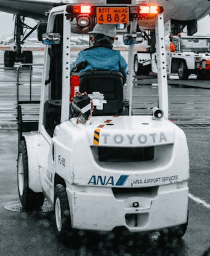
Toyota forklifts mostly use Toyota’s own industrial engines – petrol/LPG engines such as the 4P, 5K, 4Y and 1FS, and diesels such as the 2J, 1Z, 1DZ, 1DZ-II, 1DZ-III, 2Z, 1ZS and 14Z-II – and current North American 40- models use a Kubota engine. This guide shows which engine is fitted to which forklift, their main specifications, oil and coolant capacities, service data, and the repair manual to use for each engine. The data comes from Toyota’s 5FG/5FD and 7FG/7FD service manuals, the 8FG/8FD operator’s manual and Toyota specification sheets.
Engine overview
| Engine | Fuel | Displacement | Rated output | Maximum torque | Engine weight | Forklift series |
|---|---|---|---|---|---|---|
| 4P | Petrol / LPG | 1,493 cc | 35 PS (26 kW) at 2,800 rpm | 10.5 kgf·m (103 N·m) at 1,800 rpm | 128 kg (282 lb) | 5FG (1986–1989) |
| 5K | Petrol / LPG | 1,486 cc | 38 PS (28 kW) at 2,800 rpm | 11.5 kgf·m (113 N·m) at 2,000 rpm | 93 kg (205 lb) | 5FG (from 1989), 7FG |
| 4Y | Petrol / LPG | 2,237 cc | 54 PS (40 kW) at 2,400 rpm * | 16.5 kgf·m (162 N·m) at 1,800 rpm | 134 kg (295 lb) | 5FG, 7FG, 8FG |
| 2J | Diesel | 2,481 cc | 44–50 PS (32–37 kW) at 2,500–2,700 rpm | 14.5 kgf·m (142 N·m) at about 2,000–2,200 rpm | 214 kg (471 lb) | 5FD (1986–1989) |
| 1Z | Diesel | 2,953 cc | 60 PS (44 kW) at 2,400 rpm | 18.5 kgf·m (181 N·m) at 1,600 rpm | 237 kg (523 lb) | 5FD (2–3 t) |
| 1DZ | Diesel | 2,486 cc | 55 PS (40 kW) at 2,400 rpm | 17.0 kgf·m (167 N·m) at 1,600 rpm | 190 kg (419 lb) | 5FD (from 1989) |
| 1DZ-II | Diesel | 2.5 L | – | – | – | 7FD, 8FD (1–3 t) |
| 2Z | Diesel | 3.0 L | – | – | – | 7FD, 8FD (2–3.5 t) |
| 1DZ-III | Diesel | 2,486 cc | 17.5 kW at 1,700 rpm (ISO 1585) | – | – | 8FDF15/18 (Europe) |
| 1ZS | Diesel, 3-cylinder | 1,795 cc | 41 kW at 2,200 rpm (ISO 1585) | – | – | 8FDF20–35 (Europe) |
| 1FS | Petrol / LPG | 3,685 cc | 65 kW at 2,350 rpm | 276 N·m at 1,600 rpm | – | 8FG35N–50N |
| 14Z-II | Diesel, 6-cylinder | 5,204 cc | 56 kW at 2,100 rpm (3.5–5 t) · 66 kW at 2,400 rpm (6–8 t) | 269 N·m at 1,600 rpm · 325 N·m at 1,000 rpm | – | 8FD35N–80N |
| Kubota WG2503 | Gasoline / LPG | 2,491 cc | 56 / 58 hp (42 / 44 kW) at 2,600 rpm | 165 / 175 N·m | – | 40-8FGU15–32 (North America, current) |
* Early 4Y engines in 1–1.75 t 5FG trucks (1986–1989) were rated 45 PS at 2,100 rpm. Outputs are Toyota’s ratings for forklift use, with the engine governed to a maximum speed (see below), so they are lower than the same engines in road vehicles. kW and N·m values are converted from PS and kgf·m.
Which engine is in my Toyota forklift?
The engine model is on the engine itself, and the frame number punched on the truck starts with the vehicle model. On the 7-series, the number in front of the model tells you the engine and transmission:
| Capacity | 5K (petrol) | 4Y (petrol) | 1DZ-II (diesel) | 2Z (diesel) |
|---|---|---|---|---|
| 1.0 t | 7FG10 / 02-7FG10 | – | 7FD10 / 02-7FD10 | – |
| 1.5 t | 7FG15 / 02-7FG15 | 40-7FG15 / 42-7FG15 | 7FD15 / 02-7FD15 | – |
| 1.75 t | – | 42-7FG18 | 02-7FD18 | – |
| 2.0 t | 7FG20 / 02-7FG20 | 40-7FG20 / 42-7FG20 | 60-7FD20 / 62-7FD20 | 7FD20 / 02-7FD20 |
| 2.5 t | 7FG25 / 02-7FG25 | 40-7FG25 / 42-7FG25 | 60-7FD25 / 62-7FD25 | 7FD25 / 02-7FD25 |
| 3.0 t | – | 7FG30 / 02-7FG30 | 60-7FD30 / 62-7FD30 | 7FD30 / 02-7FD30 |
| K2.0 / K2.5 t (compact) | 7FGK20/25, 02-7FGK20/25 | 40-/42-7FGK20/25 | 7FDK20/25, 02-7FDK20/25 | – |
| K3.0 t | – | 7FGK30 / 02-7FGK30 | 7FDK30 / 02-7FDK30 | – |
| J3.5 t | – | 7FGJ35 / 02-7FGJ35 | – | 7FDJ35 / 02-7FDJ35 |
In each pair, the first model has a manual transmission and the second (prefix ending in 2: 02-, 42-, 62-) has a torque converter (automatic). As the table shows, the prefix alone does not always identify the engine – the same prefix 02- is used with the 5K, 4Y, 1DZ-II and 2Z – so check the engine plate or the vehicle model list in the service manual.
Governed speed and engine service data
Forklift engines have a governor that limits the no-load maximum speed. Checking it is part of the periodic maintenance: a governor set too high wears the engine and makes the truck dangerous; too low and the truck lacks lifting speed.
| Engine | No-load maximum speed | Idle speed | Notes |
|---|---|---|---|
| 4P, 5K (5-series) | 3,050 rpm | – | 5FG trucks |
| 4Y (5-series) | 2,600 rpm (2,450 rpm on early 1–1.75 t) | – | 5FG trucks |
| 4Y (8-series) | 2,570 rpm | 750 ± 30 rpm | Ignition timing 7° BTDC at 750 rpm, firing order 1-3-4-2, hydraulic valve lifters (no valve adjustment) |
| 2J, 1Z, 1DZ (5-series) | 2,600 rpm (2J: 2,300 rpm on 1–1.75 t) | – | 5FD trucks |
| 1DZ-II (8-series) | 2,600 rpm | 750 +250 rpm | Valve clearance (warm): IN 0.18–0.22 mm, EX 0.33–0.37 mm |
| 2Z (8-series) | 2,400 rpm | 750 +250 rpm | Valve clearance (warm): IN 0.15–0.25 mm, EX 0.31–0.41 mm |
Compression (8-series)
| Engine | Standard | Limit |
|---|---|---|
| 4Y | 12.5 kgf/cm² (178 psi, 1.23 MPa) at 250 rpm | 9.0 kgf/cm² (128 psi, 0.88 MPa) |
| 1DZ-II | 29 kgf/cm² (412 psi, 2.84 MPa) at 260 rpm | 20 kgf/cm² (284 psi, 1.96 MPa) |
| 2Z | 33 kgf/cm² (469 psi, 3.24 MPa) at 260 rpm | 20 kgf/cm² (284 psi, 1.96 MPa) |
Test compression with the engine warm, all spark plugs or injectors removed, and the battery fully charged so the cranking speed reaches the value shown. A cylinder below the limit, or two neighbouring low cylinders, points to worn rings, valves or a head gasket problem – see our Toyota head gasket guide.
Engine oil and coolant capacities
| Engine | Engine oil | Oil specification |
|---|---|---|
| 5K, 4Y | 4.0 L (1.06 US gal) | API SD/SE/SF (5-series), SH/SJ (7-series), SL/SM (8-series). 5K: SAE 30 (SAE 20 in cold areas). 4Y: SAE 20W-40 (10W-30 in cold areas) on 5- and 7-series; on the 8-series, SAE 40 above 30 °C, SAE 30 at 0–30 °C, SAE 20 at −10–0 °C |
| 1DZ (5-series) | 6.5 L (1.7 US gal) | API CC/CD diesel oil, SAE 30 (SAE 20 in cold areas) or 10W-30 |
| 1DZ-II | 7.9 L (2.09 US gal) | 7-series: API CE/CF; 8-series: API CF-4 |
| 1Z, 2Z | 9.0 L (2.38 US gal) | Diesel oil (API CC/CD for 1Z; CE/CF or CF-4 for 2Z) |
Coolant – 7-series (excluding reservoir tank)
| Engine | Transmission | 1 t series | K2 / K3 t series | 2, 3, J3.5 t series |
|---|---|---|---|---|
| 5K | Manual | 6.0 L (1.58) | 6.0 L (1.58) | 6.1 L (1.61) |
| Torque converter | 6.5 L (1.72) | 6.5 L (1.72) | 7.6 L (2.01) | |
| 4Y | Manual | 7.0 L (1.85) | 8.2 L (2.16) | 8.4 L (2.22) |
| Torque converter | 8.5 L (2.24) | 8.5 L (2.24) | 9.6 L (2.53) | |
| 1DZ-II | Manual | 6.7 L (1.77) | 6.9 L (1.82) | 7.1 L (1.87) |
| Torque converter | 7.2 L (1.90) | 7.2 L (1.90) | 8.3 L (2.19) | |
| 2Z | Manual | – | – | 8.1 L (2.14) |
| Torque converter | – | – | 9.3 L (2.46) |
Values in brackets are US gallons. Reservoir tank: 0.6 L (0.16 US gal) at the FULL mark on the 7-series. Use long-life coolant at 30–50 %. For 8-series capacities, see our 8FG/8FD maintenance schedule.
Coolant – 5-series from 1989 (excluding reservoir tank)
| Engine | Transmission | 1.0–1.75 t | 2.0–2.5 t | 2.75–3.0 t |
|---|---|---|---|---|
| 5K | Manual | 5.5 L (1.45) | 5.7 L (1.50) | – |
| Torque converter | 7.3 L (1.93) | 7.0 L (1.85) | – | |
| 4Y | Manual | 7.5 L (1.98) | 7.7 L (2.03) | 10.0 L (2.64) |
| Torque converter | 9.3 L (2.46) | 9.0 L (2.38) | 9.6 L (2.53) | |
| 1Z | Manual | – | 9.4 L (2.48) | 9.7 L (2.56) |
| Torque converter | – | 8.7 L (2.30) | 9.3 L (2.46) | |
| 1DZ | Manual | 5.8 L (1.53) | 8.0 L (2.11) | 8.3 L (2.19) |
| Torque converter | 7.6 L (2.01) | 7.3 L (1.93) | 7.9 L (2.09) |
Reservoir tank on the 5-series: 1.1 L (0.3 US gal) at the FULL mark.
Repair manuals for each engine
The forklift (chassis) service manual does not cover engine overhaul. Toyota publishes separate industrial engine repair manuals – the 7-series manual lists them as:
| Engine | Toyota repair manual |
|---|---|
| 5K | CE617 |
| 4Y | CE602-1 |
| 4Y-ECS (supplement) | CU642 |
| 1DZ-II | CE618-1 |
| 2Z | CE625-1 |
| 7FG/7FD chassis | CE024 |
Your Toyota forklift dealer can supply these manuals. For the 4Y engine, the cylinder head bolt torque of the related 4Y-EC road engine is listed in our Toyota head bolt torque specs – confirm the value for the industrial engine in manual CE602-1 before use.
Component weights (5-series)
Useful when planning an engine or transmission removal with a hoist:
| Component | Weight |
|---|---|
| Engines | 5K 93 kg (205 lb) · 4P 128 kg (282 lb) · 4Y 134 kg (295 lb) · 1DZ 190 kg (419 lb) · 2J 214 kg (471 lb) · 1Z 237 kg (523 lb) |
| Manual transmission | 78 kg (172 lb) |
| Torque converter assembly (Aisin) | 152 kg (335 lb) one-speed · 163 kg (359 lb) two-speed |
| Differential and front axle with brakes | 210 kg (463 lb) 1 t · 260 kg (573 lb) 2 t · 318 kg (701 lb) 3 t |
| Counterweight | about 430 kg (1.0 t) to about 1,860 kg (3.0 t) |
Always use the lifting points and special tools given in the service manual, and support the truck on stands – never work under a truck held only by a jack.
Sources: Toyota 5FG10–30 / 5FD10–30 service manual (engine performances, component weights, recommended lubricants); Toyota 7FG/7FD10–30 repair manual supplement (vehicle models, lubricants, related repair manuals); Toyota 8FG/8FD 10–35 operator’s manual (service data); Toyota specification sheets for the Core IC Pneumatic (2023), 8FGF/8FDF and 8FG/8FD 35N–80N. Conversions: 1 PS = 0.7355 kW, 1 kgf·m = 9.807 N·m, 1 kgf/cm² = 0.0981 MPa. Always confirm values in the manual for your truck’s serial number. See all our Toyota forklift guides.